Penrith City Local History - Places - Suburb profiles - St Marys
BREADCRUMBS_STMARYS
St Marys
St Marys
St Marys is located on the eastern side of the Penrith Local Government Area. Its western boundary is South Creek with the M4 Motorway as its southern boundary. Marsden Road and Sydney Street divides this suburb from the smaller suburbs of Colyton and Oxley Park on its eastern boundary. Its northern section takes in the previously named industrial suburb of Dunheved. St Marys has a long and rich industrial and agricultural history including tanneries and munitions. The area which is now the suburb is much reduced from its historical perspective known as St Marys. This suburb is the major industrial, commercial and residential centre for the eastern side of the local government area. This suburb services many rural and urban communities, making it a vital part of the City of Penrith.
St Marys on Google Maps.
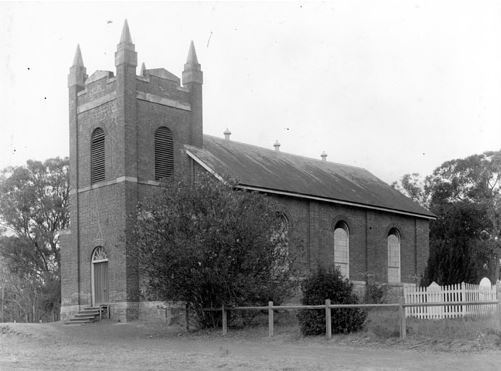
St Mary Magdalene Anglican Church
Phillip Parker King donated the land on which St. Mary Magdalene Church was to be built in a style similar to St. Mary Magdalene Church in Dunheved, Cornwall, England. The foundation stone was laid on 22 November 1837, the same day as St. Stephen’s in Penrith. The bricks for the church were made from clay found on the Dunheved estate. The church was completed in 1840 with Bishop Broughton returning for the April consecration service. The bricks were cement-rendered and the original slate roof was later replaced with tiles. Inside, the north wall bears a fine glass window to the memory of John King Lethbridge. The cemetery has many impressive headstones marking the passing of important characters in Australian history: The King & Lethbridge families and many other well known St. Marys family names: Hackett, Charker, Turner, Andrews and Beacroft.
Bronte
The two-storey house on the corner of King and Gidley Streets, was once the home of James Bennett of the famous firm of ‘G and J Bennett’, wheelwrights and wagon builders of St Marys. The wagons produced by the Bennett firm gained a national reputation for quality in the late 1800’s and the early 1900’s. Completed in 1889, the house was designed by architect Mr W. Sykes and was built by local St Marys builder, Joseph Sainsbury.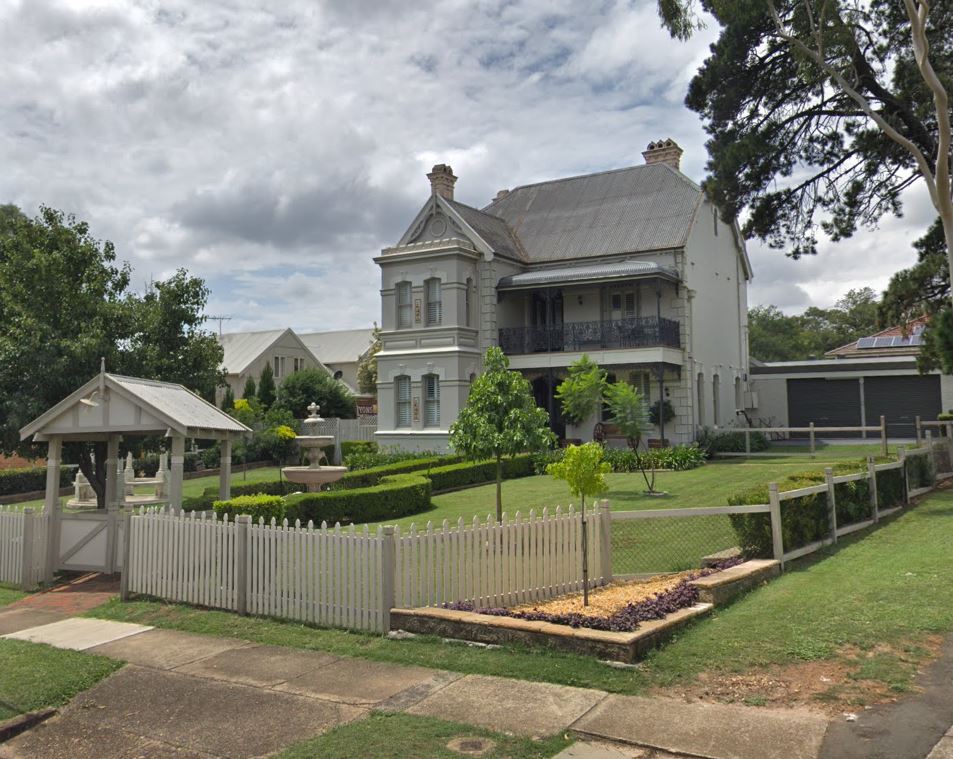
Photo by Google maps
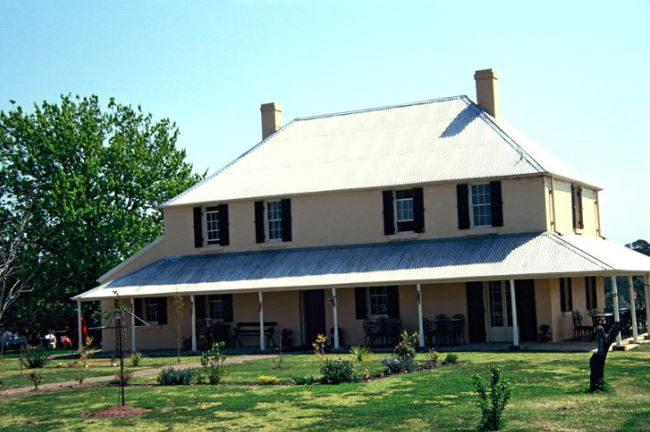
Mamre
Originally owned by Reverend Samuel Marsden, Mamre got its name from the Old Testament, Genesis 13, Verse 18: “Then Abram removed his tent and came and dwelt in the plain of Mamre, which is in Hebron.” By the end of 1794, Marsden had purchased 128 acres at South Creek near St. Marys. In 1804, Marsden was granted an extra 1,030 acre in the same location. On this grant Marsden was to build the house “Mamre”. An article in the “Nepean Times” newspaper, 19th July, 1924 (p.2) suggests that some sort of building on “Mamre” was used as a wool store in the very early 1800’s. It is thought that the original building was intended to be a wool store, but upon partial completion, it was turned into a residence. Although the actual date of completion is not certain, the National Trust suggests that the building that we now know as “Mamre” was built somewhere between 1830-1840.
Mimosa
Situated at the corner of Putland Street and Pages Road, St, Marys, the two-storied house Mimosa stands today as one of the most elegant and historic houses of the area.Former owner, Dr David Chandler restored the house to its former glory. The house was originally built for St Marys tannery owner and businessman, Andrew Thompson.
Completed in 1894, it was designed and built by local building contractor Joseph Sainsbury. According to a report in the Nepean Times newspaper at the time of its completion, Mimosa was considered to be “without a doubt, the costliest building in the Nepean district”. The building created considerable interest at the time, the local newspaper making frequent references to its progress. Finally, in the first issue of 1895, the Nepean Times reported that the Thompson family has shifted into their new home. The house was at first lit by acetylene gas, chosen by Andrew Thompson in preference to electricity as being the most economic. Some of the original gas fittings still remain a feature of its beautiful restored house. This fine example of late-Victorian architecture was classified by the National Trust in October, 1980.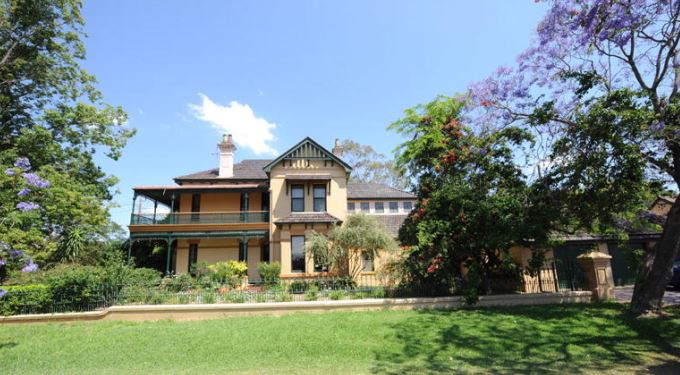
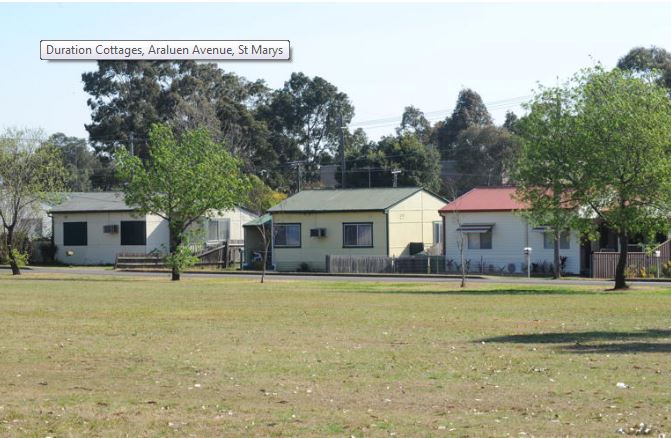
St Marys Duration Cottages
During World War II a munitions factory was established in St Marys employing up to 3500 people so houses were built to accommodate some of these new employees. They were given the name of Duration Cottages as they were only intended to remain for the duration of the war, however most are still standing today around their central park. The cottages are a heritage conservation area.
| 1804 | Land grants made along South Creek by Governor King | |
| 1806 | Land grants to King family ratified by Governor Bligh | |
| 1813 | May | Blaxland, Lawson and Wentworth set out from Gregory Blaxland’s farm Leeholme to attempt to cross the Blue Mountains |
| 1817 | Phillip Parker King (son of Gov. King) married Harriet Lethbridge in St Mary Magdalene Church in Launceston Cornwall near Dunheved Castle | |
| 1822 | Construction of Mamre homestead begins | |
| 1827 | Harriet King arrives in Sydney with her brother Robert Copeland Lethbridge. Harriet settled at Dunheved estate and Robert built Werrington House | |
| 1832 | After the death of John Oxley, his property at St. Marys is purchased by Phillip Parker King. Ann Josepha King, Phillip’s mother chose a site for an Anglican Church | |
| 1834 | Travellers Rest Inn opened. First in the district | |
| 1837 | 22 November | Foundation stone laid for St Mary Magdalene Anglican Church |
| 1839 | First school opened with 39 pupils | |
| 1839 | South Creek Inn opened | |
| 1840 | 22 April | St Mary Magdalene Church is consecrated |
| 1840 | 1 October | First Post Office opened on the O’Connell estate |
| 1842 | 26 May | First town allotments sold from the O’Connell estate |
| 1850 | John Page opened a large tannery along South Creek | |
| 1852 | Andrew Thompson born in St Marys, elder son of Samuel Thompson, tanner. | |
| 1853 | 15 April | Woolpack Inn opened by James Hackett |
| 1862 | 7 July | Railway line from St Marys (South Creek) to the Crossroads (Kingswood) opened. |
| 1863 | 27 July | National School opened |
| 1878 | 15 March | St Marys Public School opened |
| 1879 | 30 May | Branch of Bank of New South Wales opened near Victoria Park |
| 1882 | October | Andrew Thompson enlarged his tannery to take up 77 hectares |
| 1885 | 1 August | The name St Marys appeared on a railway timetable replacing the name South Creek |
| 1886 | Mimosa built for Andrew Thompson by John Sainsbury | |
| 1887 | 12 October | Andrew Thompson celebrated the opening of his enlarged tannery |
| 1889 | James Bennett’s home Bronte built by Joseph Sainsbury | |
| 1890 | 4 March | St Marys proclaimed a Municipality |
| 1890 | Newmarket Cattle saleyards built | |
| 1892 | Foundation stone laid by Cardinal Moran for a Catholic Church | |
| 1897 | June | Station Street re-named Queen Street in honour of Queen Victoria’s Diamond Jubilee |
| 1910 | 29 April | Telephone exchange opened |
| 1918 | 30 October | Andrew Thompson died at his home at Tyrone Erskine Park |
| 1941 | St Marys Industrial Estate established | |
| 1941 | Munitions filling factory established on 3,500 acres | |
| 1946 | Government leased 600/700 acres of Commonwealth land for private industrial use | |
| 1949 | 1 January | Castlereagh, Mulgoa, St. Marys and Penrith Shires amalgamated to form the Municipality of Penrith |
| 1955 | New High School built | |
| 1955 | 8 October | First electric train between Blacktown and Penrith, including St Marys |
| 1961 | September | St Marys South Public School opened |
| 1988 | 9 February | Governor King’s headstone relocated from England to St Mary Magdalene Church |
| 2003 | South Creek is dual named as Wianamatta, meaning ‘Mother Place’ in the Dharug language |